One ship list can name the village your ancestor left
A passenger manifest is not just proof that someone crossed the Atlantic. After 1906 it became, by accident of bureaucracy, one of the most precise pointers to a European hometown you will ever find — provided you know which columns to read and which ones quietly lie. Most people glance at the name, the age, and the ship, then close the file. The columns that matter are on the right-hand pages, and they are the ones almost nobody scrolls to.
Here is what those forms actually recorded, why they changed in 1906 and again in 1907, and how to turn a column entry into a place you can search.
Why 1906 and 1907 are the dates that matter
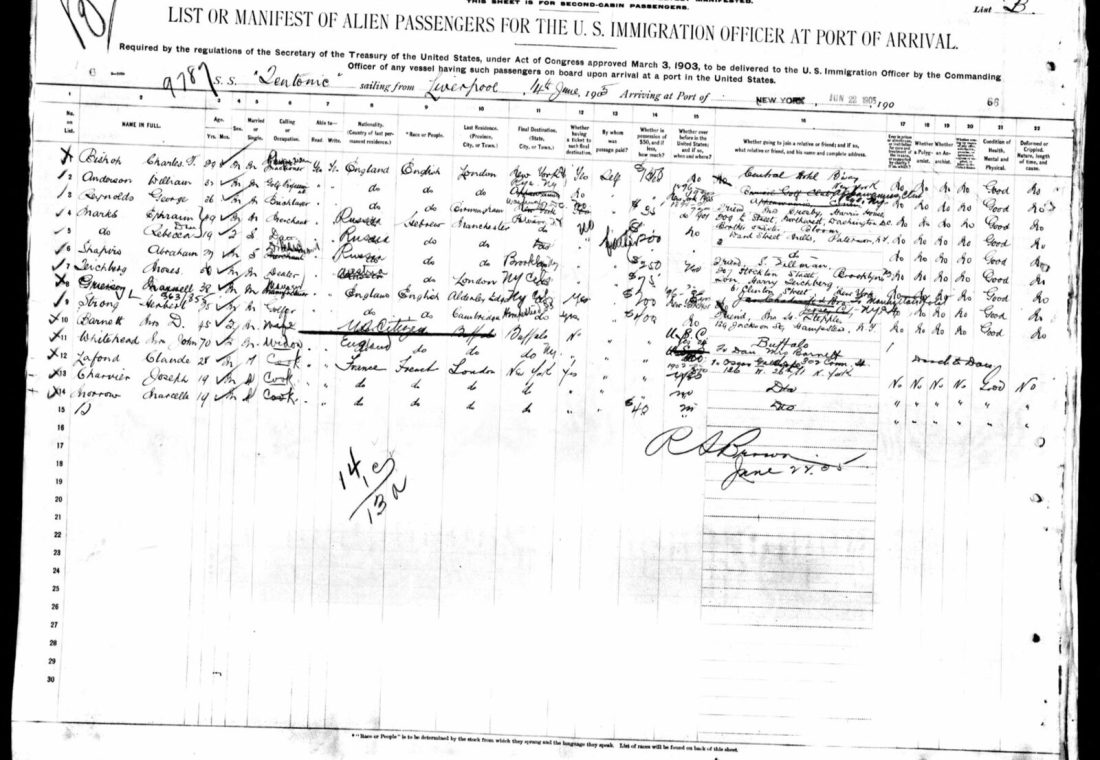
The “manifest” is the List or Manifest of Alien Passengers that the shipping line was legally required to fill out at the port of departure and hand to US immigration on arrival. The form was not static. The version adopted in 1906 expanded the questions, and the 1907 Immigration Act expanded them again, so that by 1907 each passenger record runs across two facing pages — roughly thirty columns in total.
If your ancestor arrived before mid-1906, you’ll likely get name, age, occupation, nationality, and last residence — useful, but thinner. From 1907 onward the forms are gold. Always check the arrival date first, because it tells you which set of columns to expect.
The three columns that name the village
1. Last place of residence
Found on the left page, this is where the passenger lived immediately before sailing. For someone who farmed the same village their whole life, this is the ancestral town. For someone who moved to a city for work first, it may be a way-station — but even then it narrows the region. Read it against a period map, not a modern one: a 1908 entry of “Lemberg” is today’s Lviv, Ukraine, and “Pressburg” is Bratislava.
2. Place of birth (1906 onward)
The 1906 form added a birthplace column — country and city/town. This is the one you most want, because it survives even when the family later moved. Clerks abbreviated brutally and spelled phonetically, so treat the entry as a sound, not a spelling, and run it through a gazetteer.
3. Nearest relative or friend in the country whence the alien came
This is the sleeper column, added in 1907, and it is frequently the most precise of all. The passenger had to name the closest relative left behind and that person’s address. That address is regularly the home village — sometimes the exact house: “father, Wojciech Nowak, Zalasowa.” A mother or father still living in the old village hands you the parish to search next. When the birthplace column is smudged or generic, the relative’s address often saves the search.
If you only read one line on a post-1907 manifest, read the nearest-relative column. A parent’s address in the old country is a direct line to the parish register.
The supporting columns that confirm a match
The expanded forms recorded a small biography you can cross-check against your home-country records:
- Whether going to join a relative, and that relative’s name and US address — links the manifest to the person you already know in the census, confirming you have the right traveler.
- Final destination in the US — should match where you find them in the next census.
- Marital status, ability to read and write, and the language — the language column (“Polish,” “Ruthenian,” “Slovak”) often resolves an ambiguous “Austria” or “Russia” into an ethnic region.
- Physical description and money carried (1907 forms) — height, complexion, and identifying marks help separate two same-named passengers on the same voyage.
- Whether previously in the US, and when — many “immigrants” had crossed before; this column reveals earlier manifests to find.
Where these manifests live, and how to read both pages
The Ellis Island records (1892–1924, with the immigration station opening in 1892 and the bulk of the great migration passing through it) are indexed and free at the Statue of Liberty–Ellis Island Foundation site, and the same images appear on the major subscription platforms and on FamilySearch. Castle Garden (1820–1892) preceded Ellis Island and has its own, sparser index. Canada’s arrivals are in the Library and Archives Canada passenger lists; Australia’s are in state-archive shipping records and assisted-passage lists.
The single most common mistake: viewing only the left-hand page. Indexers photograph the manifest as two images, and the birthplace and nearest-relative columns are on the second image. When you find a hit, always click forward to the right-hand page — the village is usually there, not on the page the index dropped you on.
Reading around the errors
The clerk who wrote the manifest spoke English and heard the place name once, often through an interpreter. Expect: phonetic spellings (“Posen” for Poznań), German exonyms for Slavic towns, the district capital written instead of the actual village, and the occasional column simply left blank. Don’t reject a record because the spelling is wrong; reject it only if the corroborating columns — destination, relative, age, language — fail to line up with what you already know.
Turn the column entry into a parish
Once you have a town name from a manifest, the next step is identifying the parish that kept the baptismal register, then crossing into the European archives. Knowing the borders and naming conventions of the empire your ancestor left — German, Austro-Hungarian, Russian — is what keeps you from searching the wrong country’s records entirely.
Our European Roots Field Guide eBook includes a chapter dedicated to manifests, with annotated examples of each column on the 1907 form and a checklist for converting a residence or relative entry into the correct parish and archive. It picks up exactly where this article leaves off.
Before you dig in, grab our free Getting-Started cheat sheet — it has a one-page manifest column map you can keep beside the image while you read. Find the ship first, then read all the way to the right. The name of the village is usually two columns past where you stopped looking.