You don’t have to speak the language to read the record
You’ve found the parish, located the right year, opened the baptismal register — and the page might as well be a drawing. Spiky German script that looks like a cardiogram. Latin abbreviated to stubs. Cyrillic letters that don’t match the Russian alphabet you half-remember. This is where most people quit, convinced they need a degree or a translator.
They don’t. Reading old European church records is not translation — it’s decoding. You are matching a small, recurring vocabulary (names, dates, a handful of event words) against a known script. Once you have a key for the alphabet and a list of the twenty or so words that actually appear, the page resolves into exactly the information you came for. Here is how each of the three big scripts works, and how to crack it without fluency.
German Kurrent: the script, not the language
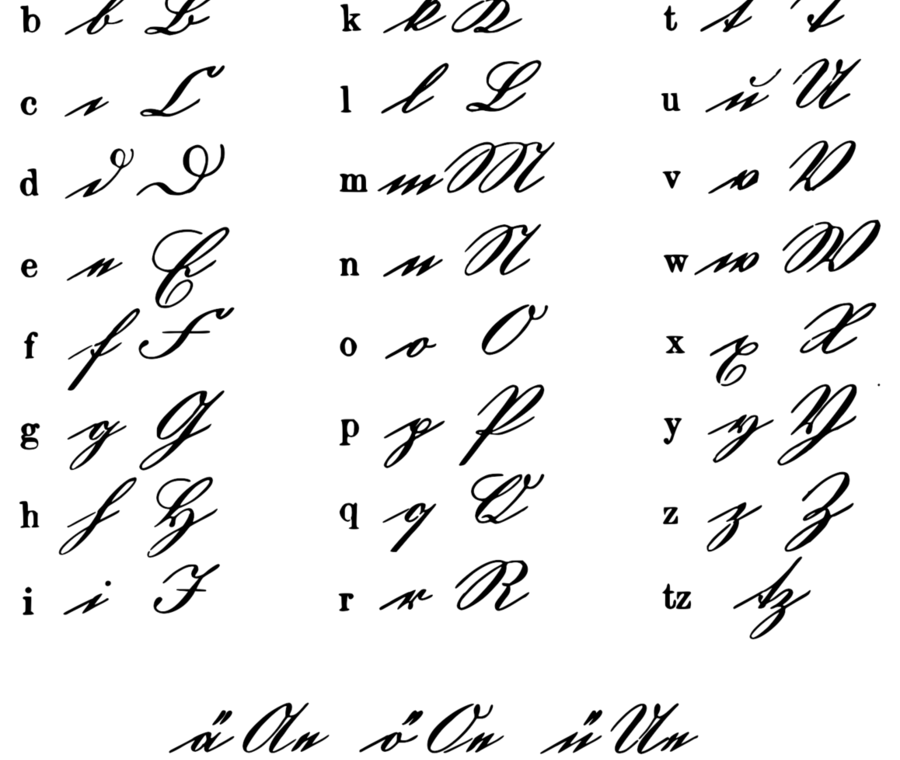
The wall in German records is rarely the German language — it’s the handwriting. From roughly the 1500s until the 1940s, German speakers wrote in Kurrent (and its tidier 20th-century form, Sütterlin), a cursive so different from modern handwriting that native German speakers today often can’t read it either. The letters are the problem, not the words.
Three quirks cause most of the trouble:
- The lowercase e looks like two tiny vertical strokes — easily confused with n or m.
- There are two forms of s: a “long s” (ſ) inside words that looks like an f, and a round s at the end of words.
- h, f, and the long s all have tall loops that blur together.
The method: get a Kurrent alphabet chart, then transcribe one known word — usually the surname you’re already searching for — letter by letter. Once you’ve decoded a name you recognize, you’ve effectively built a personal key for that scribe’s hand, because the same clerk wrote the whole register. From there, hunt for the event words you need: geboren (born), getauft (baptized), Sohn/Tochter (son/daughter), Eltern (parents), Pate/Patin (godparent). You’re now reading the record.
Church Latin: a tiny, predictable vocabulary
Catholic registers across Germany, Poland, Italy, Ireland, and beyond were kept in Latin for centuries — but it is a narrow, formulaic Latin, the same phrases repeated baptism after baptism. You are not reading Cicero; you are reading a template with the names swapped in.
Learn perhaps thirty words and you can read most entries:
- Baptismal: baptizatus est (was baptized), natus / nata (born, male/female), filius / filia (son/daughter), legitimus (legitimate), patrini / levantes (godparents).
- Marriage: matrimonium (marriage), contraxerunt (they contracted), testes (witnesses), vidua / viduus (widow/widower).
- Burial: sepultus est (was buried), mortuus / obiit (died), aetatis suae (of his/her age), annorum (years old).
The other trap is Latinized first names. Joannes is Jan/John, Georgius is Jerzy/George, Catharina is Katarzyna/Catherine, Mathias is Maciej/Matthias. The priest Latinized the given name but usually left the surname in the local language — which is why the surname is your anchor for confirming you have the right family.
Cyrillic in Russian-partition records: an alphabet, then names
For ancestors from the Russian partition of Poland, from Lithuania, Ukraine, or Russia proper, you’ll meet pre-revolutionary Russian Cyrillic — and after 1868 in Russian Poland, Catholic registers were legally required to be kept in Russian rather than Polish or Latin. The intimidation factor is the unfamiliar alphabet plus the old orthography (letters like ѣ and і that were dropped in the 1918 reform).
The breakthrough is realizing you don’t need to read Russian — you need to transliterate a known name. Take the surname you’re already searching for, write out the Cyrillic letters it would require, and scan the page for that shape. Polish surnames written in Cyrillic are phonetic, so “Kowalski” becomes Ковальскій and “Wójcik” becomes Войцикъ. Once you spot the surname, the surrounding structure — date at the top, parents named, witnesses at the end — is the same template as the Latin and Polish books.
Every church register, in every script, follows the same skeleton: a date, the principal person, their parents or spouse, and the witnesses or godparents. Find the skeleton first; the script is just the skin over it.
The universal workflow for any unfamiliar hand
- Identify the script and the era — Kurrent vs. Latin vs. Cyrillic, and whether it’s pre- or post-reform.
- Decode one known word — your surname or a town name — to calibrate the scribe’s hand.
- Find the date — usually first, often spelled out; Roman numerals and Latin month names recur predictably.
- Locate the event word — born/baptized/married/buried — to confirm what kind of record you’re looking at.
- Extract the names and ages — the parents, spouse, or deceased, plus the witnesses who are often relatives.
Five passes, and a page that looked like a code becomes a family. Practice on a register where you already know the answer — your confirmed ancestor’s own baptism — so you can check your decoding against a known result.
Keys for the three scripts, country by country
This is exactly what our country cheat sheets are built for. The Germany cheat sheet includes a Kurrent alphabet key and the German event-word list; the Poland cheat sheet covers both the Latin and the Russian-Cyrillic registers you’ll meet across the three partitions, with transliteration help; and the Italy cheat sheet gives you the Latin and Italian record vocabulary for the stato civile and parish books. Each puts the decode key on a single page you can keep open beside the scan.
Want to test-drive the approach first? Grab our free Getting-Started cheat sheet, which includes a starter list of the most common Latin record words. Open the scan, decode your surname, and the rest of the page will give itself up faster than you expect.